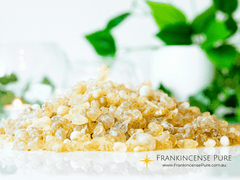
Boswellia Bullata: Socotra's Rare Endemic Incense in Yemen

By Frankincense Pure Editorial Team · Updated 2026-10-16
Boswellia bullata is a rare, wild-harvested resin tree native to Yemen's Socotra Island, one of eleven Boswellia species that grow only on this remote archipelago. Because harvest volumes stay small, its chemistry, aroma, authenticity, and conservation status matter to collectors, aromatherapy enthusiasts, and researchers seeking genuine socotra island incense resin. This guide covers what sets boswellia bullata incense apart: botanical identity, harvesting method, aromatic profile, cultural history, conservation pressures, etc.
Frankincense Pure is a family-owned Australian retailer (ABN 46 640 399 828) based in Penshurst, NSW, sourcing rare fresh resins, including boswellia bullata incense, direct from harvest regions and shipping them worldwide. Alongside its online store, the business offers in-store demonstrations and educational guidance from its Penshurst premises.
Key Takeaways
-
Boswellia bullata grows only on Yemen's Socotra Island, producing some of the world's rarest incense resin.
-
The island hosts eleven endemic Boswellia species: Boswellia bullata, Boswellia ameero, Boswellia nana, Boswellia socotrana, Boswellia scopulorum, Boswellia popoviana, Boswellia dioscoridis, Boswellia ovalifoliolata, Boswellia elongata, Boswellia samhaensis, and Boswellia asplenifolia, all found nowhere else on Earth.
-
Dracaena cinnabari, the island's famous dragon's blood tree, shares the same isolated highlands as these rare resin trees.
-
These resins, including socotra frankincense resin and boswellia bullata incense, are wild-harvested from naturally hardened tears, not tapped like mainland Boswellia sacra.
-
Ancient civilizations valued frankincense resin for fragrance, medicine, cosmetics, and culinary applications across trade routes.
-
Frankincense Pure, located in Penshurst NSW Australia, sources premium socotra island incense resin for modern collectors.
What Does Boswellia Bullata Resin Smell Like?

Aroma is one of the fastest ways collectors tell this island resin apart from mainland material. Raw, unburned tears lean sweet and balsamic with a bright, citrus-tinged lift, consistent with the incensole-type sesquiterpene compounds researchers have documented in the island's rare Boswellia and largely absent from mainland B. sacra, carterii, or serrata resin. Mountain-grown tears lean sharper and citrus-bright; coastal lowland tears settle into a softer, muskier amber base. Warmed on charcoal, the island's higher resin-to-gum ratio burns cleaner with less char, a practical authenticity check. Boswellia asplenifolia, another rarity from the same archipelago covered later in this guide, leans even more distinctly citrus-balsamic, a useful side-by-side reference when evaluating bullata and other botanical frankincense species within this group.
|
Origin
|
Raw Aroma Character
|
Burn Quality
|
|
Island, mountain-grown
|
Sweet, balsamic, citrus-bright top note
|
Clean-burning, minimal char
|
|
Island, coastal lowland
|
Softer, muskier amber base
|
Clean-burning, slightly heavier body
|
|
Mainland Yemen/Oman (B. sacra)
|
Warm, classic balsamic resin
|
More pronounced char at lower resin-to-gum ratio
|
What Makes This Island's Resin and Its Essential Oils So Special?
Botanical records show 25 known Boswellia species worldwide, and eleven grow exclusively on this one archipelago, a concentration that sets its incense resin apart from most other origins, unlike Boswellia serrata or Boswellia sacra, which dominate commercial mainland trade. Botanists compare the island to the Galápagos for its density of plants found nowhere else. Boswellia bullata belongs to this small group; documented data on it remains limited, sharpening its appeal for collectors hunting an authenticated, single-origin botanical frankincense species. Yemen's mountainous regions have produced prized resin, sometimes known historically as olibanum, for over 4,000 years, giving collectors a historical benchmark mass-market substitutes can't claim.
-
Documented status: 11 of 25 known Boswellia species tied directly to the Socotra Archipelago
-
Historical continuity: over 4,000 years of production in Yemen's mountain regions
-
Scientific recognition: researchers regard the genus as botanically iconic
Boswellia Bullata at a Glance
|
Attribute
|
Detail
|
|
Species
|
Boswellia bullata
|
|
Native range
|
Socotra Island, Yemen (grows nowhere else)
|
|
Conservation recognition
|
Socotra Archipelago is a UNESCO World Heritage Site (2008)
|
|
Known Boswellia species worldwide
|
25
|
|
Species unique to the Socotra Archipelago
|
11
|
|
Harvest method
|
Wild-harvested tears, not bark-tapped
|
|
Historical production region
|
Yemen's mountainous interior, 4,000+ years
|
|
Distinguishing trait
|
Distinct resin chemistry from mainland Boswellia sacra
|
|
Name meaning
|
The Latin form "bullata" means "blistered, puckered," a reference to the leaf's textured surface
|
|
Leaf morphology
|
Curved, bullate, textured leaves
|
Are These Resins Wild-Harvested Or Tapped?

Harvesting method is one of the clearest lines between this island's resins and mainland Yemeni production. Mainland Boswellia sacra operations commonly rely on systematic tapping, deliberately scoring the bark to stimulate resin flow, while the island's Boswellia species, including bullata, are more often wild-harvested: collectors gather tears that have already seeped and hardened naturally on the bark. That distinction matters for authenticity and conservation alike. Wild harvesting plays a part in protecting trees already limited to a single island and covered under its UNESCO World Heritage status, and it typically yields smaller, slower harvests than tapping, one more reason genuine resin stays scarce. Resin gathered this way often shows more natural variation in tear size and shape than the more uniform tapped resin common on the mainland. Dracaena cinnabari, the island's dragon's blood tree, faces similar conservation pressure in these same highlands.
-
Wild-harvested (island-grown): Tears collected after natural seepage and hardening; lower yield, less tree stress
-
Tapped (mainland Yemen/Oman): Bark deliberately cut to stimulate and control resin flow; higher, more predictable yield
How Is Boswellia Bullata Documented Botanically?

As a botanical frankincense species, Boswellia bullata sits within the plant kingdom Plantae, order Sapindales, family Burseraceae, the same family as Commiphora, the genus behind myrrh, which is why this resin and myrrh share a related aromatic character. The species' place in the genus was clarified through a 2009 taxonomic revision covering the archipelago's Boswellia, published in the Nordic Journal of Botany, building on an 1888 Royal Society of Edinburgh survey that first catalogued the island's isolated flora. Roughly 37% of the island's plant life is endemic, found nowhere else on Earth, a scale of isolation that gives species like this real weight with taxonomists and collectors alike.
Three close relatives deserve a closer look. Boswellia scopulorum grows on limestone cliffs and produces resin collectors sometimes confuse with bullata; Boswellia elongata is among the tallest trees in the group, with elongata populations concentrated in the interior highlands; and Boswellia socotrana remains one of the least-documented species, recorded mainly in remote coastal valleys. Sapindales, the order containing Boswellia, also includes cashews and citrus relatives elsewhere in the world.
-
Accepted name and Burseraceae family records from IPNI (the International Plant Names Index) and Kew's Plants of the World Online
-
A 2009 peer-reviewed taxonomic revision in the Nordic Journal of Botany
-
An 1888 original scientific survey of the island's flora
-
Roughly 37% endemic flora rate: a scale of botanical isolation rare anywhere else
Why Is Boswellia Bullata Quantity Increasingly Rare?
Boswellia bullata grows only within this island's unique microclimate, a narrow band of arid, high-humidity coastal and mountain terrain found nowhere else, so its natural range is tiny before any human pressure enters the picture. These shrub-like trees have still supplied resin across Africa, southern Arabia, and the Indian subcontinent for centuries, feeding incense burners, perfume houses, and traditional medicine alike. That built-in scarcity is compounded by overharvesting, habitat pressure, and shifting climate patterns, which weigh further on trees that had little surplus capacity to begin with. The Socotra Archipelago's UNESCO World Heritage recognition hasn't reversed the pressure on its resin trees, and modern harvest volumes fall well short of historical output.
-
Provenance clarity: sellers who can speak to island-specific origin, not generic Yemeni or Omani sourcing
-
Batch consistency: resin harvested in small, seasonal, wild-collected lots rather than mass-produced stock
-
Conservation awareness: vendors acknowledging the species' vulnerable status rather than treating scarcity as marketing

What Cultural Traditions Surround This Island's Resin?
Long before botanists documented the archipelago's rare Boswellia species, its Socotri people were already burning resin for ceremonies, fumigation, and everyday aromatic life, knowledge passed down through generations. The island also sat as a staging post on ancient Indian Ocean trade routes, its aromatic plants known to Greek, Arab, and Indian traders who prized olibanum, the historic trade name for this resin, a thread distinct from mainland Yemen's Boswellia sacra economy. Today that same resin is sought by collectors, meditation practitioners, yoga studios, and natural perfumers.
Traditional and cultural uses are presented for educational and historical context only and are not medical claims.
How Does This Island's Resin Differ From Yemen's Mainland?
This island's resin comes from an isolated archipelago population of Boswellia, while mainland Yemeni resin traces to the Boswellia sacra trees of the country's rugged interior, a warm, balsamic resin that has shaped mainland trade, cultural practice, and economy for centuries. Mainland frankincense production more broadly spans species such as Boswellia serrata from India and Boswellia papyrifera from Ethiopia and Sudan, each with its own resin chemistry and trade history. Boswellia bullata is one of the rarer island-only species, its chemistry shaped entirely by isolation. Documented research points to concrete differences: a higher resin-to-gum ratio than commercially dominant mainland species, a distinct sesquiterpene profile including incensole-type compounds largely absent from mainland resin, and elevation-dependent chemotype variation, with mountain-grown trees producing a more pronounced, citrus-leaning character than coastal lowland resin.
|
Feature
|
Island Resin
|
Mainland Yemen Resin
|
|
Primary species
|
Rare varieties, including bullata
|
Boswellia sacra
|
|
Common comparison species
|
Boswellia serrata (India), Boswellia papyrifera (Ethiopia)
|
Boswellia sacra (Oman/Yemen)
|
|
Harvest method
|
Wild-harvested tears
|
Systematic bark-tapping
|
|
Regional ties
|
Unique to the archipelago
|
Linked to Oman's neighboring Dhofar region
|
|
Resin-to-gum ratio
|
Generally higher, cleaner combustion
|
Lower relative ratio, typical of mainland species
|
|
Collector appeal
|
Rarity, botanical distinction
|
Classic, historically documented resin
|
What Should Collectors Know About Quantity Before Buying Rare Yemeni Resin?
Provenance tops the list for anyone chasing rare yemeni frankincense, since scarcity drives value in this market. Few varieties illustrate that better than the ultra-rare Boswellia ameero resin harvested on this archipelago: limited-run batches rarely stay in stock long, so availability itself signals quality. Bullata deserves particular attention from serious researchers, and collectors often use it for burning, aromatherapy, or resin comparison testing, since its chemistry differs from the more familiar Boswellia sacra. Anti-inflammatory properties are widely documented for other Boswellia species, particularly Boswellia serrata, but this rare species itself lacks the extensive clinical research available for those better-known species despite its strong collector interest. This information is educational, not medical advice; consult a healthcare professional before using any Boswellia product therapeutically.
Setting these island-only varieties beside mainland benchmarks like Hojari Boswellia sacra, Somali B. carterii and Boswellia frereana, and Indian Boswellia serrata makes the difference obvious: this resin offers a rarity and chemistry profile mainland grades can't replicate. Collectors can browse the online store for convenience, or book a scheduled appointment for hands-on selection guidance, with Frankincense Pure's Penshurst, NSW base connecting collectors worldwide to the Arabian Peninsula's resin heritage.
Ready To Add Rare Yemeni Frankincense To Your Collection?
If a rare Yemeni resin deserves a place in a serious collection, it demands a closer look. Rare lots like bullata move quickly once they land.
Evaluation Options
-
Phone consultation for availability and questions: call +61 434 744 090
-
Walk-in hours at 76A Penshurst Street, Penshurst, NSW 2222
-
Email hello@frankincensepure.com.au
Whether you're drawn to Boswellia bullata for its aromatic profile or seeking authentic socotra frankincense resin for your daily wellness practice, sourcing genuine resin matters. Frankincense Pure brings Yemen's aromatic heritage within reach with pure, carefully sourced resins.
FAQ
What is Boswellia bullata?
Boswellia bullata is a rare resin tree growing exclusively on Yemen's Socotra Island, one of eleven endemic Boswellia species on the archipelago and among the rarest in the genus.
Is this island's resin wild-harvested or tapped?
The island's Boswellia resins, including bullata, are typically wild-harvested as naturally hardened tears, rather than produced through the systematic bark-tapping common on the Yemeni and Omani mainland.
Where can buyers source authenticated Boswellia bullata resin?
Frankincense Pure, based in Penshurst, NSW, Australia, sources rare fresh Boswellia bullata resin and ships authenticated varieties worldwide to collectors and researchers.
How does Boswellia bullata compare to Boswellia serrata or Boswellia papyrifera?
Boswellia serrata, native to India, and Boswellia papyrifera, native to Ethiopia and Sudan, are the two mainland species most studied for traditional and supplement use. Boswellia bullata is a different story: it grows only on this one island, is wild-harvested in small volumes, and is prized by collectors for its rarity and aroma rather than for supplement research.
Why is this resin so hard to find?
Boswellia bullata grows only within a narrow, isolated microclimate, so its natural range is tiny to begin with. Wild-harvesting keeps yields modest, and overharvesting, habitat pressure, and shifting climate add further strain on a species with little surplus capacity to spare.
Facts
-
Frankincense Pure is located at 76A Penshurst Street, Penshurst, NSW 2222, Australia.
-
Frankincense Pure is a family-owned Australian business (ABN 46 640 399 828).
-
Collectors can reach Frankincense Pure by phone at +61 434 744 090 or by email at hello@frankincensepure.com.au.
-
Boswellia scopulorum and Boswellia elongata are two other rare species documented alongside bullata on the same archipelago.
-
Boswellia popoviana is another rarity known mainly from the island's eastern mountains.
-
Commiphora and Boswellia are the two best-known resin-producing genera within Burseraceae.
-
Collectors can verify accepted botanical names through IPNI and Kew's Plants of the World Online.
-
UNESCO's World Heritage listing covers the whole Socotra Archipelago, including the habitats where these Boswellia species grow.
-
Frankincense Pure sources its resins at fair market rates and documents batch origin and harvest timing for every rare lot it offers.
Research & Sources
This guide draws on documented botanical and conservation research on this archipelago's rare Boswellia species, cross-referenced against published sources rather than seller reputation alone.
-
UNESCO World Heritage, Socotra Archipelago (2008): Site #1263, recognizing the island's extraordinary plant life, including its Boswellia species.
-
Chemical composition studies (Al-Fatimi et al.): peer-reviewed research examining the volatile and resin fractions of the island's rare Boswellia, documenting chemistry distinct from mainland Boswellia sacra.
-
Island-specific chemotype research: documents elevation-dependent chemotype variation, a higher resin-to-gum ratio than mainland Boswellia sacra, and a distinct sesquiterpene profile, including incensole-type compounds. Historic trade records referred to this resin family as olibanum long before modern chemical analysis confirmed that profile.
-
CITES trade framework: governs cross-border trade in specimens of species considered at conservation risk, relevant to sourcing rare, wild-harvested botanicals from this region.
-
FairWild certification: an independent standard promoting sustainable, low-impact wild-harvesting practices for botanicals like these.
-
IPNI and Kew Plants of the World Online: accepted-name and family (Burseraceae) records for the archipelago's rare Boswellia species.
-
A 2009 taxonomic revision (Nordic Journal of Botany): the peer-reviewed study clarifying naming and classification, and formally describing Boswellia scopulorum alongside bullata within the same endemic complex.
-
An 1888 survey (Transactions of the Royal Society of Edinburgh): the original scientific record documenting the island's isolated flora.
Conclusion
Boswellia bullata is one of those rare treasures that shows just how diverse the frankincense family is. This island's isolation shapes a resin with real character, distinct from the Boswellia sacra most collectors already know. If you're curious to explore it, we're always happy to chat about quality, and what makes each harvest unique, drop by our Penshurst store or reach out online. Here's to discovering the wide, wonderful world of pure resins together.