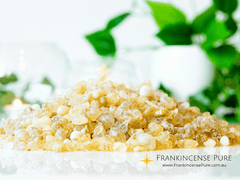
Boswellia Popoviana Frankincense Resin – Socotra Island, Yemen
Boswellia popoviana Hepper is a rare frankincense tree endemic to Socotra Island, Yemen, valued for an aromatic resin harvested in small quantities by local Socotran communities and classified as Vulnerable on the IUCN Red List. Among the least commercially available frankincense species, it draws interest from wellness-focused buyers, incense users, aromatherapy enthusiasts, and collectors seeking ethically sourced, high-quality natural resin that is wild-harvested from naturally exuded resin and NOT tapped.
This page examines Boswellia popoviana’s botany, natural habitat, conservation status, aromatic profile, practical burning guidance, how it differs from other Boswellia species, and the harvesting and sourcing practices behind this uncommon frankincense. For readers choosing rare incense with care, its scarcity, distinctive aroma, and vulnerable status make those details especially worth understanding.
Key Takeaways
-
Boswellia popoviana is an endemic frankincense tree confined to Socotra Island, Yemen, where it grows on rocky limestone slopes and cliffs at elevations up to around 600 metres. It is classified as Vulnerable (VU D2) on the IUCN Red List.
-
The species produces aromatic resin used in incense, harvested by Socotran communities in small, seasonal quantities. Boswellia popoviana resin is less studied than B. dioscoridis and other Boswellia species, with no direct clinical trials available.
-
Boswellia popoviana features a swollen caudex-like base, simple leaves and striking rose-red flowers, distinguishing it from other species in the genus. The tree can grow up to 6 metres tall, though some references cite a range of 5 to 15 metres.
-
Frankincense Pure is a family-owned Australian retailer specialising in rare Socotran frankincense and myrrh resins, offering authenticated Boswellia popoviana resin with documented species identity, Socotra provenance and harvest season.

What Is the Boswellia Popoviana Frankincense Tree?
Boswellia popoviana frankincense resin is the natural aromatic exudate of the frankincense tree Boswellia popoviana Hepper, a deciduous species confined to Socotra Island, Yemen. Formally described in 1971 in Hooker's Icones Plantarum, the species was named after George Basil Popov, who collected early botanical material on Socotra in 1953. The name is accepted by IPNI, Kew's Plants of the World Online and Thulin's 2020 treatment of the genus.
Boswellia popoviana belongs to the Burseraceae family alongside better-known frankincense trees such as Boswellia sacra, Boswellia bullata and Boswellia ameero. It has simple leaves, distinguishing it from other Boswellia species with compound foliage. The tree features a swollen caudex-like base and produces striking rose-red flowers.
Botanical fact summary: Scientific name: Boswellia popoviana Hepper (1971). Family: Burseraceae. Plant type: small to medium deciduous frankincense tree. Height: up to 6 m in most field observations, though some references cite 5 to 15 m. Native range: Socotra Island, Yemen. Habitat: rocky limestone slopes, dry woodland and shrubland. Boswellia popoviana frankincense resin is not widely traded globally; most incense users know Boswellia sacra instead. Frankincense Pure offers this as a distinct, single-origin natural incense resin with verified species identification.
Origin and Natural Habitat on Socotra Island
Socotra Island sits in the north-western Indian Ocean as part of Yemen. UNESCO recognised it as a World Heritage site in 2008; of Socotra's roughly 825 plant species, about 37% (307 species) are endemic. Boswellia popoviana is among those endemics and is not found on mainland Yemen or other regions.
The species thrives in subtropical or tropical dry forests and grows on rocky limestone slopes and cliffs across north-central and southern Socotra. It requires extremely well-drained rocky or sandy soils. Associated vegetation includes Adenium obesum, Dendrosicyos socotranus and other xerophytic shrubs. Altitude records range from near sea level to around 600 m, though precise upper limits vary by locality. Socotra's climate is hot and semi-arid, shaped by two monsoon seasons: a summer monsoon (May to September) bringing fog and coastal drizzle, and a winter monsoon carrying rain to northern areas. Strong sun, thin soils and persistent wind produce the slow growth and compact stature typical of cliff-rooting Boswellia trees.
What Makes Boswellia Popoviana Frankincense Rare?
Boswellia popoviana is classified as Vulnerable (VU D2) on the IUCN Red List (assessment by A. Miller, 2004), indicating a very restricted area of occupancy and limited number of known locations. The species is also listed as Vulnerable or Endangered depending on the assessment framework applied. Its rarity stems from a narrow endemic range on one island, small and scattered sub-populations, and poor natural regeneration rather than any commercial ranking.
Habitat threats to Boswellia popoviana include overgrazing by goats (which browse bark and damage young trees), habitat degradation from infrastructure expansion, climate-related events such as cyclones in 2015 and 2018, and broader climate change pressures. A 2023 field survey counted over 17,253 mature Boswellia individuals across all eleven Socotran taxa; Boswellia popoviana contributes a fraction of that total due to its cliff-rooting habit and fragmented distribution. Research on Boswellia popoviana is extremely limited and mostly focuses on botany, leaving population dynamics and demographic data incomplete.
Boswellia popoviana frankincense is rarely encountered in mainstream incense markets because large-scale harvesting has never been established.
Boswellia Popoviana Aromatic Profile
Published aromatic data for Boswellia popoviana is sparse compared with Boswellia sacra. The descriptions below reflect Frankincense Pure's direct observations of actual resin batches from Socotra rather than extrapolations from other species.
The resin granules range from pale cream to light amber, with occasional deeper honey tones. Surface texture is lightly rough; translucency varies between harvests. Unheated, the scent is gently resinous with a soft woody undertone. When burned on low heat, brighter top notes emerge before settling into a warm, lightly balsamic character. Smoke density is lighter than most Boswellia sacra grades. Boswellia popoviana resin has a unique chemical profile with compounds like caryophyllene oxide contributing to its character.
Frankincense Pure customers use Popoviana frankincense layering it with myrrh or sacra resin to explore contrasts between Socotran and Arabian frankincense trees.

How to Burn Boswellia Popoviana Frankincense Resin
Boswellia popoviana is a natural incense resin best enjoyed with gentle, controlled heat. Three methods work well:
Always burn in a stable, fire-safe vessel away from children, pets and drafts. Never leave lit charcoal unattended. For comparison sessions, burn Popoviana alongside Boswellia sacra in separate burners and keep a notebook to record impressions of different frankincense trees.
Boswellia Popoviana vs Boswellia Sacra and Other Frankincense Species
Boswellia popoviana is one of eleven or more Boswellia species on Socotra Island. It differs from Boswellia sacra in native range (Socotra vs Oman, mainland Yemen and Somalia), growth habit (cliff-rooting on limestone vs ground-rooting woodland), and resin trade status (rare specialist resin vs primary global frankincense). Traditional uses of Boswellia species include applications for inflammation, but direct clinical trials on Boswellia popoviana are not available, so such properties should not be assumed.
Among Socotran species, Boswellia popoviana's simple leaves and caudex-like trunk base separate it from Boswellia bullata (bullate leaf surfaces) and Boswellia elongata (ground-rooting, taller stature). Chemical composition data for Popoviana remain limited; its resin is less studied than B. dioscoridis and should not be treated as interchangeable with better-documented species.
Provenance, Harvesting and Conservation
Correct species identification and verified origin on Socotra Island are essential for rare Boswellia resins. Boswellia popoviana resin is harvested by local Socotran communities, often by collecting naturally exuded tears from bark wounds rather than deep tapping. The resin is also used for traditional medicine within those communities, particularly for tooth and gum complaints.
Overharvesting can weaken Boswellia popoviana trees, so sustainable practices are crucial for conserving Boswellia species with restricted ranges. Conservation cultivation is important for Boswellia popoviana's survival, though propagation material (especially seeds) remains scarce. Frankincense Pure works with small, managed harvests from local collectors. Incoming resin is stored in cool, dry conditions in light-protective containers with clear batch labelling.
Where to Buy Boswellia Popoviana Frankincense Resin
Authentic Boswellia popoviana frankincense from Socotra is not sold through mainstream retail channels. The species is sought after by collectors due to its rarity and unique characteristics, so verified provenance matters.
Frankincense Pure stocks Boswellia popoviana resin in its frankincense resin collection, alongside other Socotran and Arabian species. Free express shipping is available within Australia on qualifying orders; international shipping is offered for global collectors. Quantities are inherently limited; each batch may differ in appearance and aroma depending on micro-location and season. Browse starter kits to explore several rare species in one purchase, and sign up for restock notifications so held public stock updates reach you promptly.
Frequently Asked Questions
Is Boswellia popoviana endemic to Socotra Island?
Yes. Boswellia popoviana is currently known only from Socotra Island, Yemen. Botanical databases including Kew's Plants of the World Online list its distribution as restricted to Socotra. It has not been confirmed as native to mainland Arabia or Africa.
What climate and conditions does Boswellia popoviana need if grown in cultivation?
Based on its natural habitat, Boswellia popoviana prefers hot, arid conditions with full sun exposure and extremely well-drained rocky or sandy soils. Protect Boswellia popoviana from frost; it is not frost-tolerant. Water sparingly during establishment; rely on natural rainfall thereafter. Space trees 5 to 7 metres apart for crown development. Cultivated experience outside Socotra is very limited, and seeds are rarely available.
Does Boswellia popoviana resin have the same uses as Boswellia sacra in aromatherapy?
Boswellia popoviana resin is primarily used as a natural incense for its distinctive aromatic smoke. No specific aromatherapeutic or medicinal properties have been established through clinical research. Do not assume that reactions or findings documented for Boswellia sacra, Boswellia serrata or other species apply to Boswellia popoviana. Treat this resin as a rare aromatic material, not a therapeutic product.
How should I store Boswellia popoviana frankincense resin at home?
Keep Popoviana frankincense resin in an airtight container in a cool, dry, dark place away from direct sunlight and strong odours. Properly stored natural frankincense resins remain usable for many years. Some users notice subtle maturation of aroma over time. Avoid moisture exposure, which can cause clumping or surface degradation.
Can I blend Boswellia popoviana with other resins when burning?
Boswellia popoviana can be burned alongside other natural incense resins such as Boswellia sacra, myrrh or opoponax. Use very small quantities of Popoviana when blending so its more delicate nuances are not overwhelmed by stronger, smokier resins. Experiment with different burners and temperatures; comment on your results in a tasting notebook for future reference.